
Absolute Power (S1-S3)
S1. The Subject, S2. Representation and Its Shadow, S3. Ancient, Modern, Hypermodern

(Click here for Sections 4-6)
Absolute Power
S1: The Subject
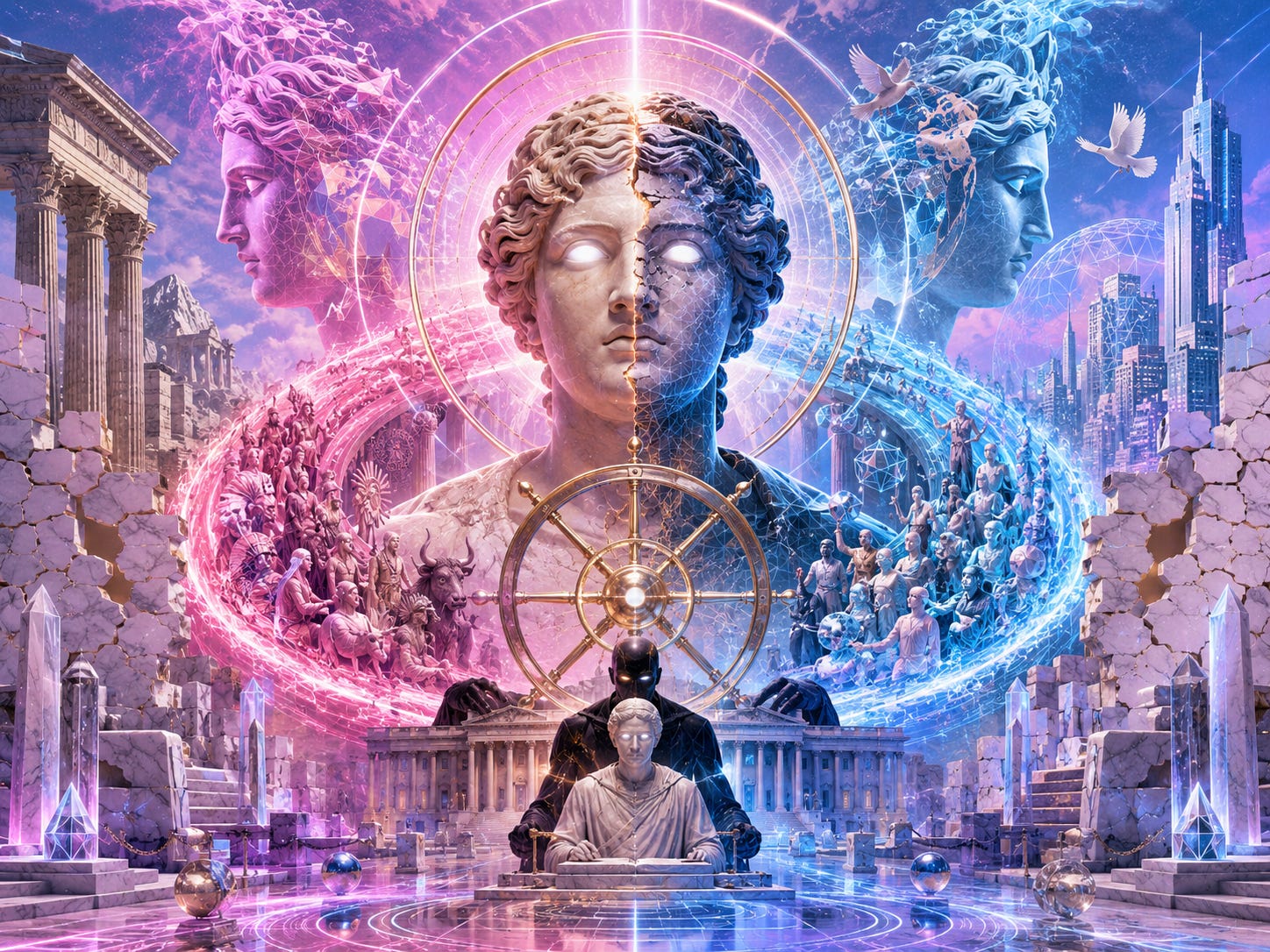
A country forms a subject with the establishment of a border. A subject also includes a border, but this border is not unchanging. In liberal democracies, nationalist parties bend the law towards a majority subjectivity within a national subjectivity, whilst referring to a universal law. Similarly, a universalist or progressive party emerges with even more reference to the law, but its purpose is not strictly universal law over nationalist corruption, but concrete advocacy for minoritarian subjectivities. A steering wheel forms in the National Subjectivity between the Nationalist Subparty and the Universalist-Minoritarian Subparty.
Within the Ego, a single person can similarly set up oppositional forces which guide the interests of particular forces in this manner.
Attempts to overcome dialectical thinking leads to an obscuring myth. This obscuring myth however, leads to an unconscious mode of steering, rather than a conscious one. The people in liberal democracy who directly advocate for subjective interests contra law are political outcasts and pariahs; however, they are simply articulating the unconscious motivations of those in power who have no choice but to reference law.
S2: Representation And Its Shadow
Those who reference law or official structures directly are representatives. Those who represent subjective desire beyond legal frameworks become shadow advisors to official legal representatives. A larger subject made of multiple people holds both official representation and shadow advisors in one subjective interest.
The split in liberal democracy is due to the fact that the law can never fully encompass desire, and those in culture can devote their lives and efforts entirely to subjective desires which exceed political representation’s description. The Shadow Advisor can also hold hard power which defines the action of the official advisor, but if it devotes itself to holding the lever directly, it has to submit itself more and more to official oversight.
S3: Ancient, Modern, Hypermodern
Postmodernity never occured. In the ancient times, tribal society appears simultaneously as an internality but an inevitable oppressive externality insofar as we had to rely on our tribes to survive. Modernity saved us from our tribal identites. What is called postmodernism generically, which is to say of course there are specific art aesthetics and so on which are postmodern, but the deconstructive nature or signifying psychoanalytic modernity which challenges the ancient world in favor of a universal perspective allows humans to be free from their ancient ties and throw themselves i to some form of enlightenment.
Postmodernity, the deconstruction and juxtaposing mode which posits a void at the center of signification, has always been hypermodern. It always has unconsciously reconstituted a rational core of its function and being, even if its “ego” or subjective representative claims to represent no more than the void.
Hypermodernity is the name of modernity’s supposed postmodernmode which knows how it is actually functioning. The ancient is grasped but transformed into the mode of universalizing and enlightening. Categories of technology and philosophy transcend peoples and create particular subjective alliances which cross-contaminate abstractly, but nonetheless inevitably are made of the same metal of Being. As we understand Being, we can see the unconscious of subjectivity, which is to say the hidden features of the world itself.
This is Hyperpsychology’s angle on reality, and what it hopes to not simply reveal, but to make available at-hand for subjectivities in a universal capacity, beyond the writer’s own particular subjective preferences, and into a world historical Absolute: a hypermodern psychology which is true for all peoples for all times.