

Absolute Power (Sections 13-15)
The Justice, Egoism, and Dream of Truth

(To begin at the start, click here for Sections 1-3)
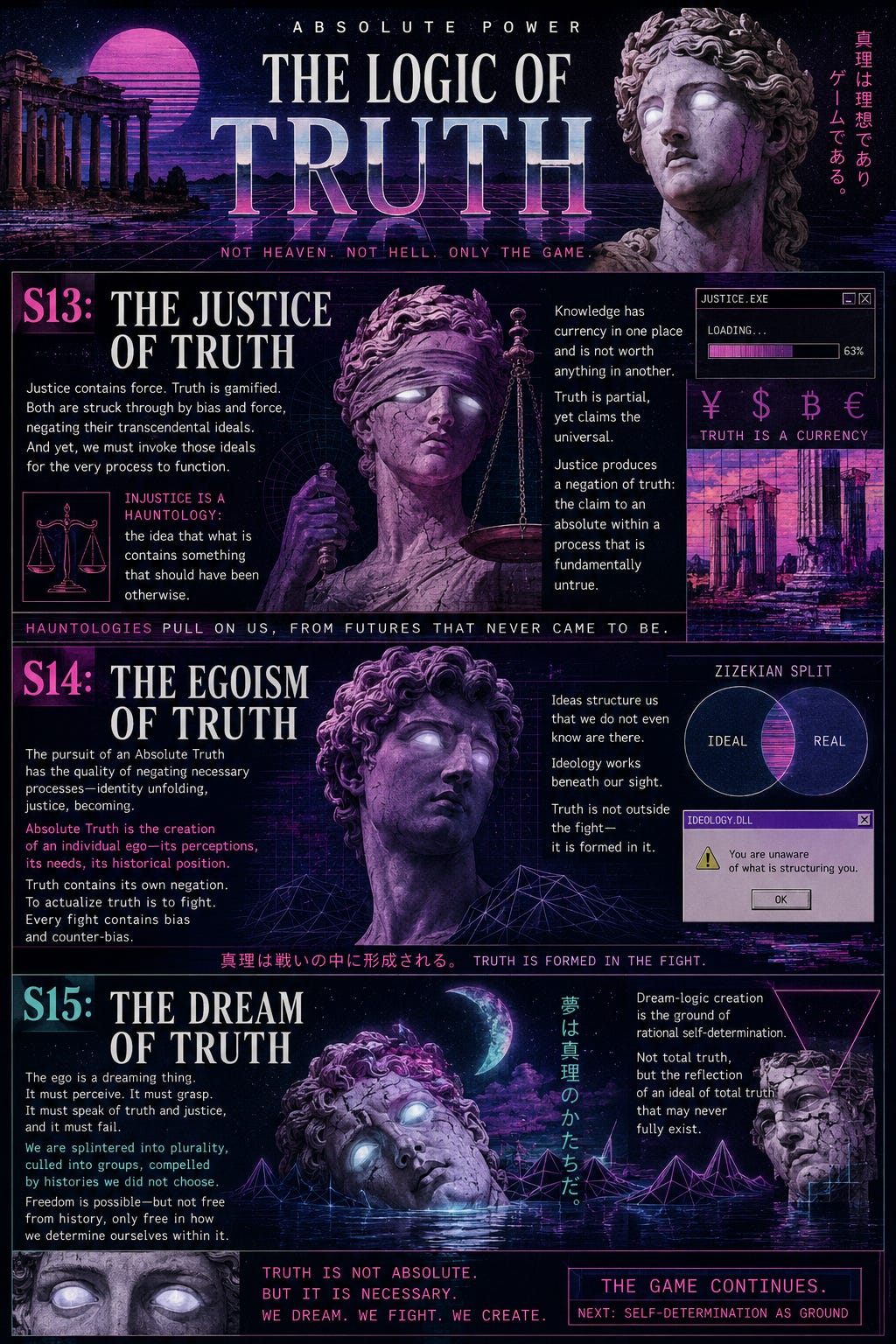
S13: The Justice of Truth
We discover justice contains within itself force, which is beyond a transcendental ideal of justice, but also contains that transcendental ideal as well as its negation which is pure force or ability. Knowledge has currency in one place and is not worth anything in another. If justice contains, through revolutionary theory, the necessity of accumulating force whilst accumulating that force around a subject or ideal, then is truth likewise gamified? Justice is struck through by both bias as well as force, two things which negate its transcendental perfect ideal of itself of being an absolute fair thing. Actual justice is gamified, with currencies of knowledge, but nonetheless things are claimed to be just and true in this process and would cease to function if these claims were not made of a transcendental ideal, despite the actual nature of both truth and justice to be gamified. Justice as established prior, is the true negation of bias and force directed for a single subjectivity’s self-bias or counter-bias, despite justice not being perfect.
Hauntology talks about futures that have never come to be, and the living spirit of the present contains what we understand psychologically as superego, id, and dream, in the form of what isn’t, which pulls on us trying to grasp at the Truth. Injustice is likewise a hauntology, an idea that what is contains something that should have been otherwise. The Actuality of Being is not only justice, but injustice. It is quite normal to see things as not yet having justice done to it, and likewise, truth is something which contains a process of coming-to-know itself within both a consciousness and a system.
The thinking of truth is partial but attempts to formulate a universal. Here inlies the common argument of absolutism of justice and truth, and the degradation of people who see that when one speaks the truth, it is subject to bias. Is there a Truth which is Absolute and unitary? If there is bias and gamification, is this not an attempt to speak the truth of bias and gamification? It is, but I have also previously stated that underlining bias and gamification may cease the processes to function. Thus, justice inevitably produces a negation of truth, which is the claim to an absolute truth within the process which is fundamentally untrue but nonetheless must exist.
S14: The Egoism of Truth
The critique, as well as the critique of critique present in the last two decades of American politics is the back and forth of bias and counter-bias relating to identity. Is there structural racism? Is structural racism critique a problem itself? Then the final question, what will be given money, what sort of decisions will be made? Actual Justice is a fight relating to what truth is relevant. What is actualized is a result of the fight between contradictory elements. The question remains to see what exists as not heaven-made-real nor hell-on-earth; rather, it is a series of game results. These game results are influenced by ideas of what is heavenly and what is hell-like, what is good and bad, what is true and untrue, what should be seen, created, and what should be destroyed.
It can be said, then, that the pursuit of an Absolute Truth has the quality of negating necessary processes of both subjective, identity unfolding, as well as justice itself. My unfolding of the truth relates neither to the perpetuation of my identity as Jewish, a white guy, a man, a married man, a millennial, and so on. Nonetheless, the critique of identity is that of course, there is something in all of these that maybe influences me stating this truth, that it is subject to my biases, and to my needs in the world. This Absolute Truth is revealed to not only be a creation of an individual Ego, its perceptions, as well as the simple reality of Being, or what is. There is a problem when one must speak the truth in that it immediately contains a negation in the truth of what is and what has been.
Truth, in an Absolute sense, contains active fights of creation. If justice contains the negation of itself through containing force to enforce itself, then truth likewise contains its own negation within the force required to actualize its own implications. In addition, truth contains within it the biases and counter-biases possible within justice. Furthermore, the historical development of what we see and what is created reveals a Zizekian split of ideology. Ideas are structuring us that we do not even know are there. These ideas can be historically developed, beyond our immediate control, and beyond our immediate sight.
S15: The Dream of Truth
The ego aligns with ideals and processes and cannot help but to perceive and create, insofar as the living thing, like a shark, must perceive, is forced to perceive, and is forced to be an object in space. When I speak of Absolute Egoism, it is not a statement of pure selfishness; rather, it is the forcing of the psyche to perceive and to exist which being alive puts on us. We recoil from questions of truth and justice as well as ideologically spew notions of truth and justice reflexively, as a dream is reflexive.
Claims of truth, justice, and self, are inevitable and failing, and the demarcation of failure, while it is part of the cause of truth, in fact negates the cause of justice, as well as the cause to determine a self. Should myself also contain that I am also something beyond myself? I demarcate limits to myself, all the while I am struck through by the fact that conceptual unfolding contradict themselves.
Marx, when asked to describe himself in a pub game, said his best quality was his single-mindedness. Hegel describes Absolute figures of history as people who, when we analyze them, represent a single idea or concept which is developed at a certain time in history. If we are not single minded, can we be seen to represent the truth? The self allows us to be perceived as the truth, while the true dream of truth beyond ourselves remains something else entirely. If we rationally understand our existence as one that dreams and one that grasps at truth, justice, and other things in society, then what is it that we should create, exactly? Clearly, here is where we are splattered into the plurality of individuals and reflexively culled back into groups by different historical subjects and causes in order to actualize some knowledges ideal. If freedom is possible, forced to exist, forced to have historical development, but not forced to think of anything but inevitably dreaming and existing, what is freedom exactly? I have argued it is rational self-determination, the ground of self-interest determined by general categories, and dream-logic style creation in general, so next we will explore what this looks like, and why it is the ground of truth which itself is not a total truth, but a reflection of an ideal of a total truth which does not necessarily exist in the same way it is reflected.