
How Creativity Mutates Ethics

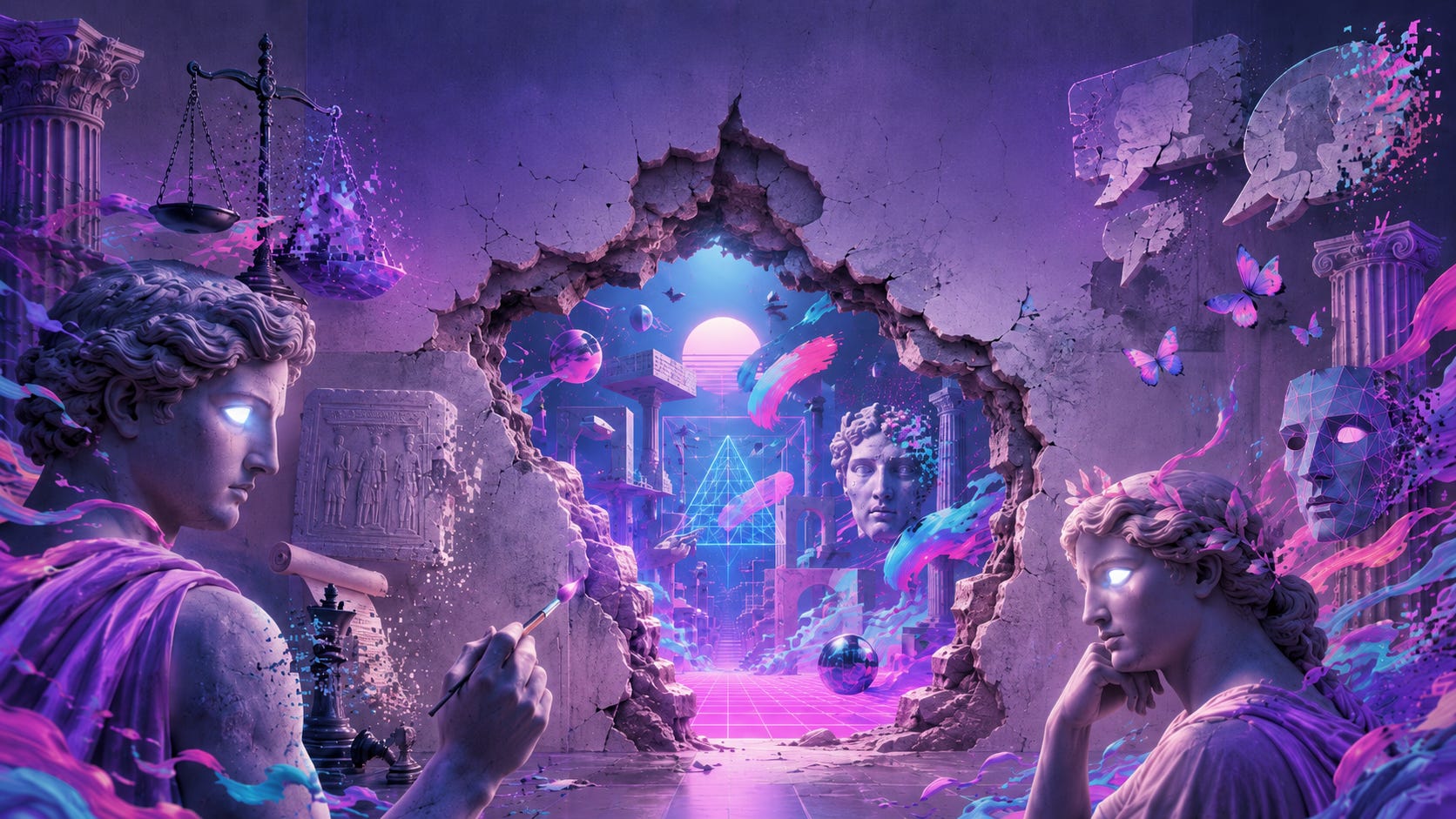
Twice weekly, I give an example in a Stoicism-informed empowerment and creativity group of Ed Hicks’ art practice. Ed Hicks is a British Muralist who decided to have his mural go inwards rather than outwards. I give this example as a creative moment that is not simply a moral proposition, but rather a counterintuitive moment which becomes the ground of a creative practice. It could be said, and I believe in a few ways Ed Hicks does use morality and ethics to supplement his choice. It is not a propaganda piece that gets in your face, it is something that draws you inwards into the work. That being said, it would be somewhat ridiculous to then claim murals that jump out at you are unethical, and murals that go inwards are more ethical. It is an aesthetic choice which results in real creative artworks going into the world.
These artworks have no single meaning, but then again, neither do words, despite their ability to pin down arguments more precisely, like a controlled ballpoint versus a loose watercolor painting. That being said, ethical ideas emerge from the creative moment, and take space both as an object in the world as well as an aesthetic preference or style within consciousness. Yet another way to read Ed Hicks’ mural work is that it is opening a crack in this world and bringing us to the weird world of world creation itself. Since his act itself is not simply an ethical imperative, nor is it a concrete necessary aesthetic moment, but rather an artistic creation, the holes can act as a gateway through which we can enter the world of art and aesthetics as such.
I teach creativity as something which can emerge from the ground of a single idea. In today’s world, we are often caught in the spectre of the debate and proof format, as if the goal of life was to recreate the democratic political process which in a formal sense, always must involve some form of debate as multiple parties representing conflicting interests emerge in order to govern. Even then, there is a creative singularity in the form of government and ruling programs which emerge from the debate, but these are very often guided by conscious intentionality. That being said, this conscious intentionality is subsequently ripped apart by contending forces as well as its own non-ability to simply unfold its program with no contradictions. When the program is self-negating, you can just grab it by the contradiction, it just lets you do it from its own principles, Hegelian Idealist Trump might say.
The Ego is a guide which constantly fails, but none the less, it is both a necessity and also exceeds itself in its production. Within politics, failure is not always subject to the political mode of democratic debate and dissolving contradictions, people can align to the contraction to strengthen the existing mode of holding the steering wheel even more, and loyalty despite failure can exist as an even stronger political mode than loyalty through commonsense. Commonsense loyalty is something most people can do, but loyalty through a small contradiction has a different effect entirely. What is often called hidden or occult knowledge is often, in fact, a system of loyalties to particular political contradictions which function to form a political party.
To understand that the world is struck through by modes of political contradiction and control fundamentally changes the gaze upon which politics is understood. In progressive blocs, the mood is generally something along the lines of, “we all know the real thing [commonsense idea], but for some reason the people in power must be stupid or evil.” In fact, the liberal is someone who holds contradictary imperatives to make concrete programs which bridge gaps which elude commonsense entirely.
Gaps must be bridged between commonsense and political imperatives, and does not Iran show the progressive commonsense itself that this is ideal? Does not progressive commonsense want peace with the Iranian government who has Islamic Dictatorship and has killed tens of thousands of protesters advocating for basic freedoms such as womens’ rights to not have to wear a hijab and conform to ultra-religious demands? Progressive commonsense of course does not care about 1000 Israeli civilians murdered, many of which did concrete work for the rights of Palestians, which doesn’t matter to commonsense, but progressive commonsense is able to grasp that it doesn’t like war. Therefore, progressive commonsense understands that gaps to genocidal women killing regimes such as Iran and the West are necessary.
Those supporting Israel even in the vaguest sort of way need no lecture that people disagree with them, nor the lines of disagreement. It is the viewpoint flooded everywhere after Israel has militarily dominated Hamas and Hezbollah in Gaza, punctuated by close-ups of destroyed housing and civilian casualties initiated by Hamas’ killing of Israeli civilians and eagerly distributed by what can only be called, progressive commonsense.
On Substack today, you can see Oxford/Cambridge-educated as well as Ivy-League graduated professors making argumnts from first principles, but what are the ground of these arguments? They are unapologetically in the philosophical form, making axiomatic proofs regarding their own defined categories. There is no room for the creative ambiguity which actively creates the world we live in.
This ethical-unfolding of first princples is not capable of grasping the very ground which they are on which overloads the philosophical mode entirely. The creative object is a gateway to a new world. A narrative hero is one who embodies an ethical pathway within the context of a creative world, but are there other modes of existence besides the hero’s journey? I argue that not only are there other modes besides the hero ethically unfolding his will in order to conquer the baddies, but that the primary mode of being is creative acts which exist in the Actual, and which exist as a global creative endeavor, always exceeding the causes which they officially represent via not only their contradictions, but through the very ground which they base their arguments on.
That being said, the dry ethicists will undoubtedly continue their mode of philosophical argumentation, but a new form of Ethics of the Real which takes the mode of self-understanding excess will emerge as an opposition to this tendency.