

Absolute Power (Sections 4-6)
Choice (Human Selection), The Myth of Necessity, The Start of Political Consequences

S4: Choice (Human Selection)
A little extrapolated corner of Darwin’s evolutionary theory is how human selection differs from natural selection. Many lifetimes have been spent trying to conflate the way humans choose things with natural selection. A whole branch of psychology, evolutionary psychology, is similarly aimed to conflate the two distinct categories of natural selection and human selection.
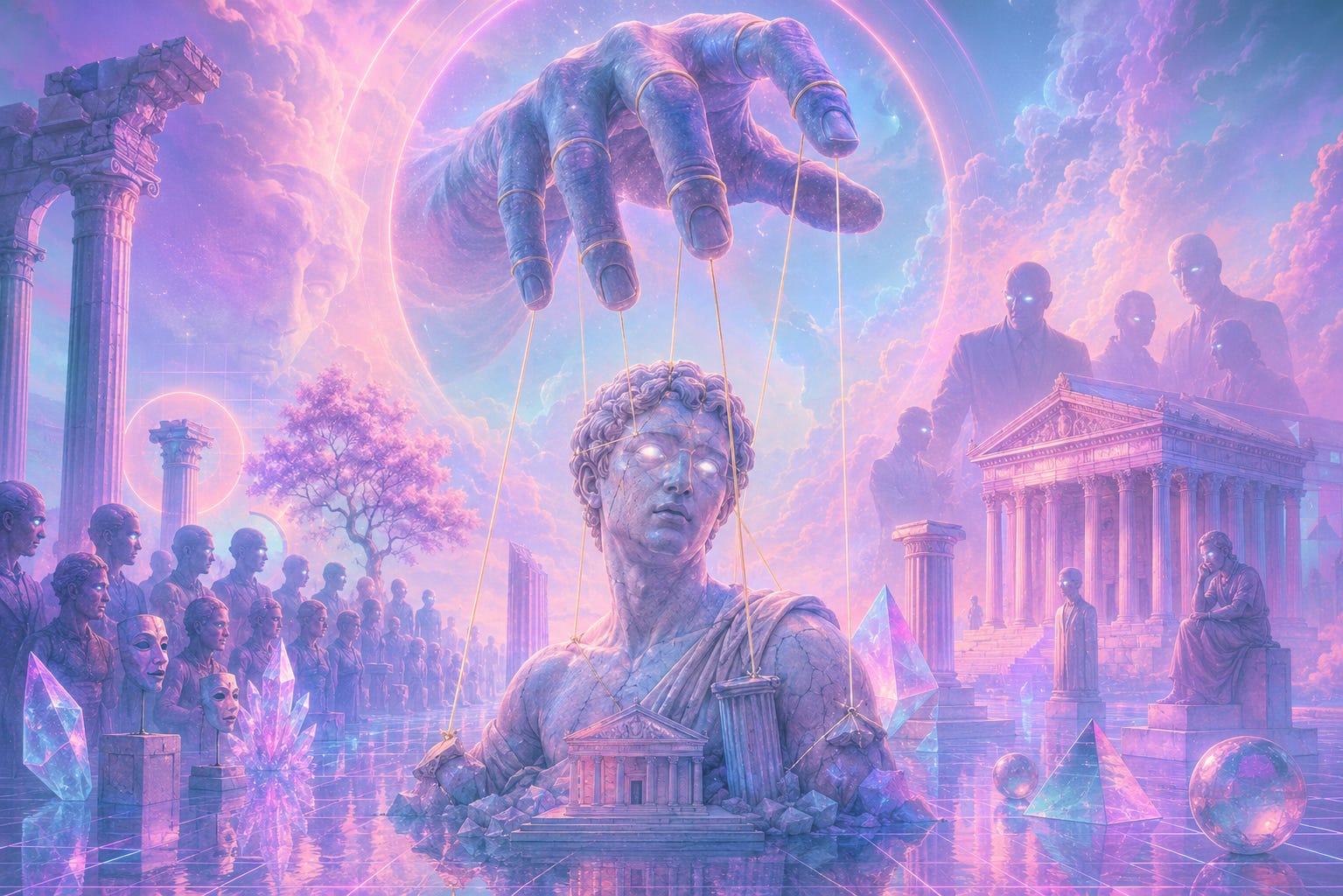
Humans choose things in a way that differs from the way that animals choose things in that humans can choose things through aesthetic preference which does not directly relate to survival and reproduction. Linguistic reference has the quality of difference and relation, where the signifiers are understood to not necessarily have some sort of essential connection. In thinking in a German Idealist manner, the development of the concept is not strictly a linguistic tree of relation, but it does in fact have some sort of essential quality in common with its surrounding signifiers. The truth lies somewhere in between, and in Hyperpsychology, we play with this truth of the battle between essential truth and post-hoc rationalization in the form of the psychoanalytic interpretation being elevated to its true ground of this in-between space, where creativity is neither essence nor strictly relative, but takes on a pragmatic, technical, and aesthetic quality all at once.
Bringing this truth back into choice, what this means is that people create camps around signifiers such as American football, or England-in-general, and associate different subcategories within them such as teams, or political programs and parties. Human Selection informs us that there is some element of relativity within this, that not all things are in an Absolute nature, strictly G-d’s plan, but that there is some arbitrary human capacity involved alongside a scientific extrapolation and development of the human condition simultaneously.
In Hyperpsychology, we understand all things as having an aesthetic dreamlike quality, where this truth is obscured, and things are inevitably churned into a myth of what is natural and necessary. Power tends to naturalize itself and assert its necessity, but it ends up creating a myth of necessity that posits its own self-interest as a universal necessity.
S5: The Myth of Necessity
The Myth of Necessity arrives to obscure power’s self-interested and arbitrary elements by referring to some elements of truth. We do not, in an Absolute sense, need to philosophize, or participate in any political program. We can in fact, bring ourselves to the grave with Stoic ideas of doing right actions in relation to obstacles, and not being overwhelmed by those obstacles. This truth which the Stoic mode suggests to us while presenting us with duties and an imaginary idea of a unitary mode of human progress has some truth to it. We do die, humanity does seem to vaguely develop technologically, and so on. Dictators do eventually die, as we and our loved ones do.
Nonetheless, this is not enough typically for humans in terms of an existential purpose to their lives. People begin to reflexively create aims for themselves, all the while naturalizing their reflexes. In fact, their reflexes are natural by their very definition. However, dream analysis shows that human reflex in fact thinks in a condensed form that bullies and pushes at our conscious mind which is trying to think in a singular and pragmatic way. The nature of human thought is that it reflexively holds problems, solutions, contradictions, as well as seemingly unrelated things together within a reflexive method of thought which is revealed by the dream.
The world as well holds this contradictory nature which is both, as established before by Hyperpsychology, both essential and post-hoc, both actually in the thing as well as created after-the-fact, and the results of this are things which are posited as natural or necessary being in fact, partial, and a reflexive demand of humanity. That reflexive demand of humanity is what is often obscured by Evolutionary Psychology and conflated with natural selection, but in fact, has this process of generating a myth of necessity or naturalness in order to enact its goals.
S6: The Start of Political Consequences
The consequence of necessity and naturalness being formulated by humans is too vast to be outlined in a single section. Humanity’s operation of consciousness, to singularize and organize into goals, are interpretations which are reflexively grasped and filtered in order to create a semblance of clockwork order. Our clockwork order, our conscious organization, sits on top of the reflexive dreamworld of all of humanity’s works.
Hyperpsychology is itself a clockwork order. There is, as I stated at the onset, not strictly a necessity to philosophical reflection. Why do I write this then? I would say that when we can get to the back of the process, we develop reason which understands the ground of its own process. With the advent of psychoanalysis and the further development of the theory of ideology within the Slovenian school, we come to a conclusion that is neither in psychoanalysis nor present in the Slovenian school of ideological unfolding itself: that humanity is dreaming, creating partial programs which posit a pseudo-universal necessity.
Slavoj Zizek mentioned my summary was fair of his work when I stated the purpose of his interpretations is to create the highest ethical idea, and this ethical idea presents itself in the gaps of what he calls the transcendental dimension. The gap of the history of psychoanalysis itself shows that lack is not an abstract thing to call upon, but the very nature of our organizations. Our partial nature means that we must take on a skeptical view of the universal Ethical idea. It is always psychological in character, and insofar as we decide something is necessary for the progress of humanity, for instance the ending of slavery, one can not strictly give into the temptation to create a dictatorship around a universal idea.
Partiality demands a representational process so that the partial nature of demands can be held within a structure that is always beyond a single individual. We now must venture next into the creation of something beyond enacting the will of a single individual, but structures which hold the will of many people all at once.
The question then remains, who can be on the inside and who can be on the outside of the structure? The official legal representatives have standards. John Aziz wrote recently that this line had been drawn at sexual assault for a democratic candidate, but not a Nazi tattoo in his article, “The Nazi Tattoo Should Have Been Disqualifying.” As we spoke about in the last moment of Absolute Power, there is official power and there are shadow representatives. Now with the latest allegations against him, Graham Platner went from candidate for official representative to not even qualifying for having shadow power—or does he? Who does the official with the sexual assault allegations and Nazi tattoo represent? His ideals don’t disappear when his official capacity goes away.
The shadow representative remains in operation, or rather, the official representative through disqualifying acts is forced into the shadows and must become a shadow representative. The political consequences of going beyond the symbolic order is a forcing moment of being pushed into the shadows by whatever order one goes against.
The shadow representative demands official representation, and thus a structure emerges which the shadow representative must then relate to in order to achieve recognition and an Actualization of their demands in the world. Human Selection then comes back to grapple with desires on the basis of their official representation. To mistake the official representation for the whole picture is to ignore the structural unconscious of who the official representation is being utilized by in the shadows.
Thus, the critique of official doctrine and revealing of ideology begins. It is revealed to be a necessity in order to produce the democratic structure of representation which must put forward an official representation which brings forward shadow forces behind it, and thus shadow meets shadow on the ground of official demands, while representing a split subject of the official demand and the shadow demands. The consequence of this is that the Neo-Nazi, the wanna-be Bolshevik, or the ignorant non-political person who just wants to be a part of things, can always get an official representative through this operation of the shadow attaching itself to the official order. It is the reverse of the physical reality of shadows, where light from the sun hits an object and the shadow appears. This is the realm of shadows positing an imagined sun and making designs around it.
The operation of naturalization and necessity is thus the shadow representative taking what is individual demand and positing an alignment with a basic facet of inevitable physics. However, because this inevitably occurs, it is thus its own Absolute, and is existent as much as the sun which hits an object, despite its metaphysical properties being an inversion of Being. The conceptual essence is thus a negative of the physical material when the sun is posited post-hoc. The consequences of this is that there is a battle to posit what is natural and necessary, despite there lacking truth to the fact that something is posited post-hoc as natural or necessary.
The political is built on a metaphysical falsehood, but insofar as it is a selected structure, it is posited as both natural and a necessity. Figures such as the illuminati or paranoid conspiracies circle around the basic truth that official representatives are not the full story.
The question remains: do we go along with lacking official representation, or do we hystericize and show that it lacks? Clearly, people do both: they naturalize and denaturalize, posit necessity and show that something could be different. The political consequence of the nature of reason is that we operate on somewhat false premises always: othering opponents, creating borders and interiority, and operating within only a certain dimension of equations. Absolute Power which knows that it operates through myth and partiality may not feel guilt for this, or if it does, it must know that it is irrational, if there is truly no other option.